

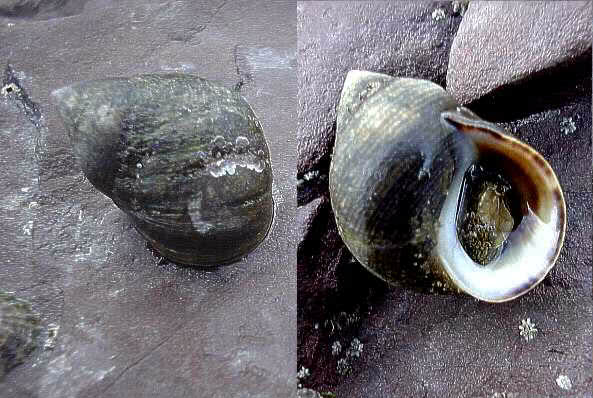
This is the so-called edible periwinkle because it is the largest, up to 6 cm tall although sizes half that are more common. The colours are not so variable as the other periwinkles, tending to be dark with lighter bands flowing through the shell.
It feeds by scraping the rock with its radula, often leaving marks. The heavy shell protects it from drying and mechanical damage, with a horny plate - the operculum - over the opening when the tide is out. Fertile eggs are released into the water and the larvae swim in the plankton. Planktonic larvae settle out on the shore and migrate up the beach, guided by responses to gravity and light. They have gills but can breathe for short periods out of water.
This one of the most widespread species on European shores found on seashores: the middle and lower zones of most rocky shores and even mud and sand. It can be seen ploughing its way through the upper layers of depositing shores although usually it collects under seaweed attached to stones in estuaries. It will be absent from extreme wave action.
Looking for a next step?
The FSC offers a range of publications, courses for schools and colleges and courses for adults, families and professionals that relate to the seashore environment. Why not find
out more about the FSC?

FEEDBACK
Do you have any questions?
Copyright © 2008 Field Studies Council

Creative Commons Attribution-Noncommercial-No Derivative Works 3.0 Licence .
Site Statistics by Opentracker